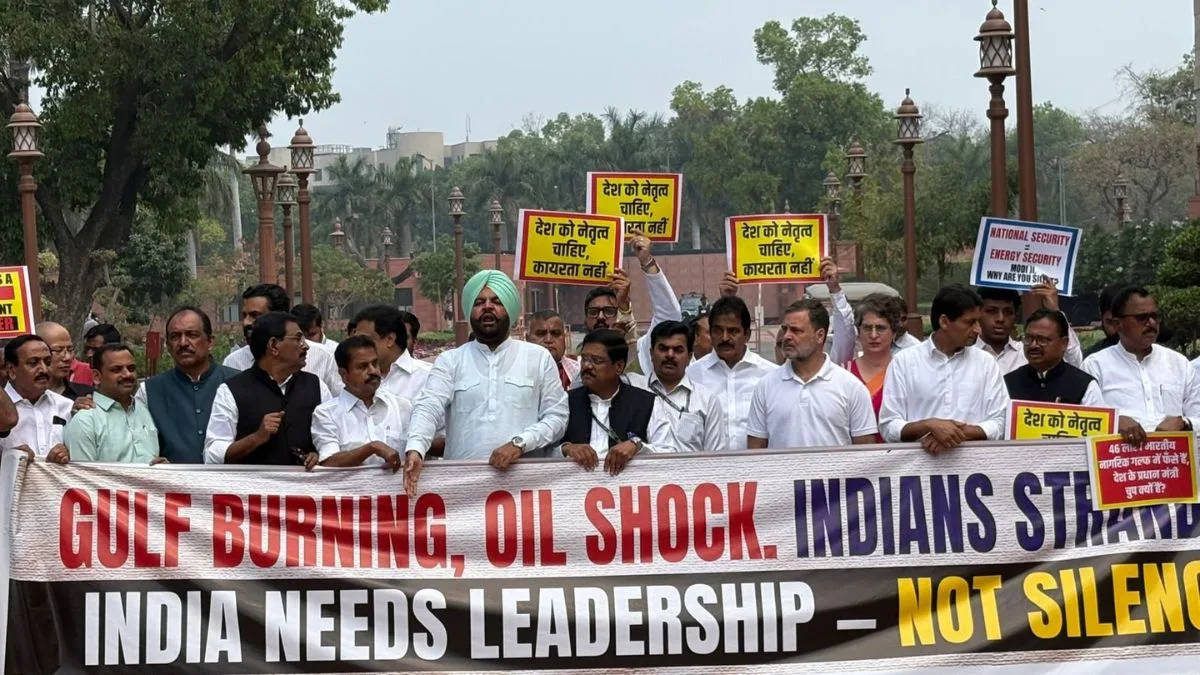
Congress’s criticism of the government over the West Asia crisis has reopened scrutiny of its own record on Iran during the United Progressive Alliance (UPA) years, when India took a series of decisions that critics said aligned New Delhi more closely with Washington than with Tehran.
The political contradiction has come back into focus as Opposition leaders question the Centre’s handling of the Iran crisis and demand a stronger response in Parliament. However, Congress-led governments themselves voted against Iran at the International Atomic Energy Agency (IAEA) multiple times, reduced oil imports from Tehran under sanctions pressure, and moved cautiously on energy projects involving the country.
Advertisement
The 2005 IAEA vote that triggered a political storm
One of the most controversial moments came in September 2005, when India backed a European Union-sponsored resolution at the IAEA that declared Iran in “non-compliance” with its nuclear safeguards obligations.
The resolution passed by 21 votes to one with 12 abstentions, and India was among the most prominent supporters of the motion. In India, the move was widely debated since New Delhi had always maintained friendly ties with Tehran.
The decision sparked protests in India itself. At a rally organised by Left parties in New Delhi, CPI(M) general secretary Prakash Karat accused the government of yielding to US pressure and warned that antagonising Iran could damage India’s energy interests.
“The rally is not to defend Iran but to defend India’s national interest,” Karat said as per Al Jazeera, arguing that India had long-term gas agreements with Tehran.
Communist Party of India leader AB Bardhan also criticised what he described as India’s “abject surrender to America”, while Samajwadi Party leader Rampal Yadav said voting against Iran “smacks of the worst political immorality”.
A second vote against Iran followed in 2006
The controversy deepened the following year. In February 2006, India again voted with the majority at the IAEA to refer Iran’s nuclear issue to the United Nations Security Council.
According to a Congressional Research Service report on India-Iran relations, the decision triggered criticism within India, with opposition and Left parties accusing the government of aligning too closely with Washington at a time when the India-US civil nuclear deal was under negotiation.
The report also notes that the US ambassador to India had specifically associated advancement on civil nuclear cooperation with India’s upcoming vote at the IAEA, fuelling the perception that New Delhi was under pressure from Washington.
Manmohan Singh’s own remarks on Iran’s nuclear programme
During a visit to Washington in November 2009, then Prime Minister Manmohan Singh also made India’s position clear when asked about Iran’s nuclear ambitions.
“As far as Iran’s nuclear weapon ambitions are concerned, I have stated it unambiguously on several occasions that we do not support the nuclear weapon ambitions of Iran,” Singh said during a question-and-answer session at the Council on Foreign Relations.
“There is no ambiguity in our position… Iran should not go the nuclear weapon path. That is inconsistent with its obligation as a member of the NPT,” he added.
He also said that India would abide by any resolution passed by the UN Security Council, while expressing hope that diplomatic engagement with Tehran would continue.
A third IAEA vote in 2009
India again voted for an IAEA resolution critical of Iran in November 2009, when the nuclear watchdog censured Tehran over a secret uranium enrichment facility.
Reports at the time pointed out that this was the third time in four years that India had voted against Iran at the IAEA, a pattern that critics said showed the UPA government increasingly aligning with Western powers on the issue.
Oil imports from Iran were also reduced
The shift was not limited to diplomatic forums. It also began to show up in India’s energy ties with Tehran.
As the United States and the European Union tightened sanctions on Iran’s oil sector in 2012, India gradually cut back its crude imports from the country. According to the US Energy Information Administration, Iran’s crude and condensate exports dropped sharply in 2012, from about 2.5 million barrels per day in 2011 to roughly 1.5 million barrels per day, after sanctions targeting its energy sector took effect.
The sanctions regime also affected Asian buyers, including India, as restrictions on banking and shipping insurance complicated purchases of Iranian oil.
Iran pipeline project also lost momentum
Another episode frequently cited in discussions on India-Iran relations was the proposed Iran-Pakistan-India gas pipeline.
While India initially supported the project to secure natural gas supplies, the initiative faced strong opposition from the United States, which was attempting to isolate Iran economically. Analysts later linked the project’s stagnation to the evolving strategic partnership between New Delhi and Washington.
Against this backdrop, the present political attack on the government over Iran has revived debate about Congress’s own foreign policy choices when it was in power.
For critics of the party, the current protests overlook the fact that several of the most consequential departures from Tehran in India’s diplomatic and energy policy occurred during the UPA years.